

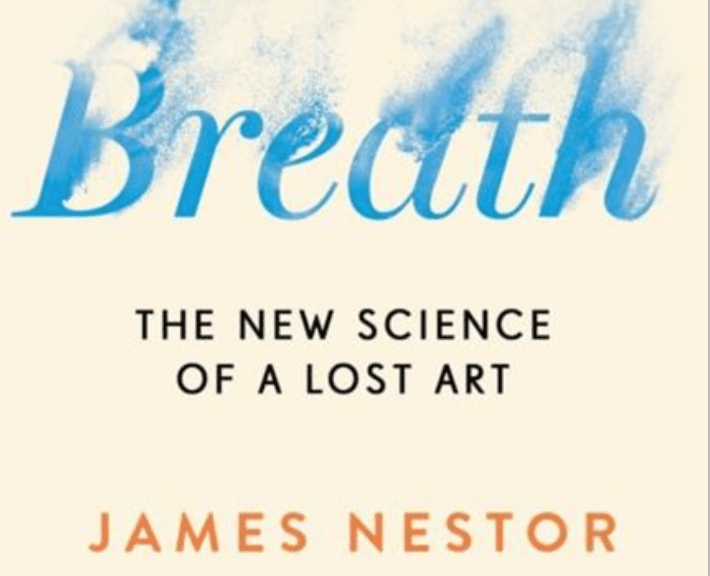
If you have any connection with the health and wellness industry, you have probably heard of “Breath: the new science of a lost art” by James Nestor. I first came across it when I attended Breathing School last year, and since then it seems to have become a sort of bible for yogis. Don’t ask me why, but for some reason I resisted reading it until now. Maybe I had a premonition that I would find it a very frustrating and disappointing read.
The positives
There is no question that the breath is hugely important. Apart from the obvious benefit of keeping us alive, slow breathing has a number of documented benefits, including lowering blood pressure, calming the mind and having broader mental health benefits. I’ve written about this before. It is likely to also affect a number of chronic diseases, including metabolic diseases, as Nestor discusses.
It is also true that not enough research is being carried out on how various breathing practices affect our body and especially how they may influence our health and any diseases we may be living with. Nestor highlights that any research that is being carried out right now is not on the whole instigated by lung specialists (pulmonologists), which is why he justifies going to alternatives (what he calls ‘pulmonauts’) to learn more about the effects of breathing.
So this is a really interesting and important topic that is absolutely worth writing about.
However…
Finishing the book left me with a sense of frustration and, to be honest, anger – how the hell is everyone raving about a book that is meant to be about the science of breathing but in reality is more about Nestor’s experiments in breath and a complete misrepresentation and exaggeration of what research actually exists? Why is this popular science and not labelled as something else?
It’s an example of why science communication should be done by people who understand how science works
I don’t believe that science communication is the domain of scientists alone. In fact, scientists frequently suck at science communication because we know too much about the topic and can’t always grasp the level of communication and what is actually interesting to the general public.
However, if you are going to write about science, or present your work as science communication, you do need to be able to discern what makes a good research study and what doesn’t, what is tentative and what isn’t, and frankly what is bullshit and what isn’t. You also need to try and catch and challenge yourself when you develop a theory and know to flag it as a theory and personal opinion vs fact.
How on earth it is a NY Times bestseller and a GoodReads nominee for Science and Technology book of the year, is beyond my understanding, since it was written by a journalist (not a scientist) with very little understanding of how to conduct a proper scientific research.
Goodreads review
N=1 vs a well-designed, controlled research study
There is no question that Nestor is a good storyteller. So much so that the narrative of the book is mainly about his experience of being forced to breath solely from the mouth and the impact this had on his body and mood.
It’s an interesting story. It’s also anecdotal, ie a personal account, which means it’s not exactly reliable. It’s the experience of one person (or rather, two people), which means that you can’t draw broad conclusions about populations, and therefore must be taken with a pinch of salt.
Plus, let’s face it, he had pretty much decided what the outcome was going to be and was using the experience to back it up (having said that, I should highlight that scientists do exactly the same, which is why we have checks and balances like controls, large studies, statistics and experiment repetition to confirm that what we observed actually happened).
But let’s forgive this because it makes for good reading; this isn’t a textbook after all. And hopefully most people can discern the difference between the experience of one person and proper research.
Amplification of poor research as fact
Pretty much everyone with a scientific training of some description always, always writes in a tentative way – this may imply this, it may suggest that, more research is needed to be sure etc (notice how often I do it, even in this book review).
The book has a lot of footnotes and appears well-researched. In a way, this may be worse than having no references at all as I think most people know to look for references to trust a source. The issue is in many cases the studies are over-interpreted or misrepresented, or the evidence is poor and not enough to warrant the certainty of language he uses.
There’s one example that stuck to my mind because I read those studies myself when I wrote my blog post and my little ‘Science of pranayama’ booklet – on alternate nostril breathing. I described the studies as ‘dodgy-looking’ because of reasons I’ve explained before. They are worth discussing, because the idea that breathing from one nostril can activate a different part of the brain is definitely interesting. But there are no “clear links”, as he says. They are just interesting observations that merit further exploration.
Confirmation bias and far-fetched claims
Which brings us to the next problem – starting to verge into fiction due to confirmation bias, the tendency to search for, interpret, favour and recall information in a way that confirms or supports one’s prior beliefs or values. Again, to be fair to Nestor, we all do it. As you can see, I’ve cherry-picked the reviews that confirm my own views of the book. I would have just thought that an editor or someone else along the way would have picked this up and challenged some of these frankly far-fetched ideas.
Let’s take the example of Katharina Schroth, who apparently cured herself of scoliosis by breathing. It sounded dubious, but I was open to the possibility. Unfortunately, it’s not entirely true. She did use breathing, and undoubtedly that could have played a part in her recovery. She also used corrective exercises as part of her treatment, but that’s not mentioned in the book. Or that the Schroth method to treat scoliosis combines postural correction, postural perception and breathing exercises (see here and here for example).
Unfortunately full of pseudoscience and overblown claims. For example he talks about Katharine Schroth in Chapter 4 describing her case of scoliosis as extreme and her being left to whither in bed. Minor research shows that her case was considered mild to moderate and she didn’t cure it with just breathing but also physical therapy. His descriptions of her clinic skip over anything that disturbs the magic of breathing storyline he’s pursuing.
Goodreads review
There are many examples like this throughout the book. I’m not even going to talk about the whole evolutionary theory he puts forward. Perhaps he would have preferred that we didn’t develop our big brains and just kept breathing better.
It’s sadly a perfect example of science-washing
There is a lot of really interesting food for thought in this book. I was prepared to go along with a lot of what was being covered. I probably would have forgiven a lot had the language used been different (ie more tentative).
But when I started spotting all the dubious claims and over-interpretations of research, I honestly couldn’t believe anything anymore.
Can breathing help calm us down? Probably. Do people have actual breathing problems? Of course. Are we all breathing wrong and nearly all our ailments can be cured by just following this author’s breathing exercises? Doubtful.
If all this is true, put in the effort and run some scientific studies, Mr. Nestor. Prove your claims, get them peer-reviewed, and show the world. It’s too easy to write a misleading book these days.
How is this a NYTimes bestseller? Perhaps it should be in the fiction category…
Goodreads review
Nestor has definitely spent a great deal of time researching this topic, I’m not going to take this away from him. Some of it is even scientifically sound. He also does highlight that not enough research exists, which I completely agree with. Unfortunately, he either lacks an understanding of science and scientific research or chose to pursue a non-evidence-based book peppered with solid science to appear more scientific (aka science-washing).
The glowing reviews and bible-like status of this book means that the pseudoscience gets perpetuated (especially in the yoga community) – after all, it’s helpful for us yoga teachers to use this as evidence that the practices we offer can have such transformative effects. (overgeneralising here, my apologies)
A missed opportunity
We have a saying in Greek: the green leaves get burnt along with the dry leaves.
This definitely applies to this book. There are good points to it, but to me it’s frankly worthless because I feel like I have to fact-check every single thing he writes. That should really have been the job of someone else before this so-called popular science book was published.
More than anything I’m disappointed because it’s a missed opportunity to write something that’s actually scientifically sound. To actually put forward good research and all the reasons why we should be investigating the breath as a call to arms for researchers around the world to spend more time on elevating the breath from wellbeing fad to key part of holistic treatments.
Or maybe, it just shouldn’t be labelled as popular science.

 GEEKY YOGA
Thanks for sharing your thoughts – well said! The yoga history was also pretty shoddy…
LikeLiked by 1 person
yikes, interesting, thanks for flagging! so really no one spent the time to fact-check or sense-check this book on all angles.
LikeLike
As a nurse anesthetist and yoga/breath teacher I thought it was an interesting read but didn’t mistake it for peer reviewed research- which I guess some might :[ I saw it more as a call FOR the science/medical community TO commit to legitimate study of how this simple/innate/powerful/free resource can be utilized to improve health. So many of my patients could potentially have better quality of life if mind/body practices were offered as adjuncts to medications
LikeLike
Good point, and I agree – but my experience of how people talk about it is that it is seen as ‘evidence’.
LikeLike
Thanks for the review. Your insights were helpful and have backed up some of the suspicions that I had about the claims in the book. It’s a shame that books with this sort of reach can’t do more to educate the readers about different levels of evidence so they can become better at critical thinking!
LikeLiked by 1 person
That’s a really good point and I guess was the focus of the podcast I was on a few months ago https://www.jennirawlings.com/podcast/nasal-vs-mouth-breathing-does-it-matter
LikeLike
Great article. I am a biologist and my chiropracter suggested I buy that book but I wasn’t so sure about its scientific value… I am not so sure about seeing a chiropractor also!
LikeLike
Thank you, glad you found it useful. I am never sure about chiropractors either but I assume that there is merit in terms of the physical manipulation
LikeLike
I fully agree with your thoughts. I’m a physio with extensive training in cardio resp and am only partway through but already frustrated by many things he’s saying. My concern is that my husband is kind of thinking I’m nuts for starting to question these things (not having a good understanding of medicine, anatomy nor scientific research methods)—which means others will read this as gospel too. Eeks.
It’s moderately entertaining so people will enjoy it, but agree it could do some harm.
I do overall agree nasal breathing is going to lead to better overall health and there are indeed many benefits. But you’d be better to follow Dr. Patrick McKeown if you want actual science-based information about this. He’s excellent.
LikeLiked by 1 person
I researched dr McKeown, and found out he represents the Buteyko breathing method. That is in no way a science-based method. Not as far as the breathing method is concerned, not as far as all the claims regarding sea salt etc.
LikeLike
I looked up “Dr. Patrick McKeown” based on the above comment. Unfortunately, he is NOT actually a doctor, so the title is misleading and may have been assumed by you because he is a Fellow of the Royal Society of Biology and the Academy of Applied Myofunctional Sciences.
According to Wikipedia, “McKeown studied at Trinity College Dublin and completed clinical training in Russia under Dr. Konstantin Buteyko, the founder of the Buteyko Breathing Method. He was awarded a Diploma in the Buteyko Method by Professor Buteyko.”
While he does seem to bring a scientific approach to breathing, I also recommend healthy skepticism there, as with Nestor and any source.
LikeLiked by 1 person
Thanks for writing this. 100% agree. Started reading it and was not having good feelings. He represents a lot as scientific fact which is definitely not. Lots of personal bias and anecdotes etc. I was sad to see it was so highly rated and well received as it is misleading and not very scientific.
LikeLiked by 1 person
I found James Nestor’s book to be very well researched. Yes, he does use his personal experimentation, but he doesn’t depend on his personal observations to explore how breathing influences well being and health. He includes many notes at the end of the book — mainly peer reviewed research — and has an extensive bibiography on his website of sources he referenced in his research (see https://www.mrjamesnestor.com/bibliography)
Nestor is a well regarded science journalist who has published in Scientific American among other publications.
I don’t agree with all of his positions but to say this book was not scientific is a disappointing assertion.
LikeLike
Hi, my apologies for not replying sooner, I completely missed your comment. I think this is one we will have to disagree on. Yes, he is a well-regarded science journalist, but as I say in my post, a lot of what he says is not backed by evidence or the evidence is stretched to fit the narrative. This is pretty standard among many journalists who don’t have a scientific background. There is a lack of discernment on what studies are ‘valid’ and what studies are just interesting observations – things like sample sizes, study design etc are really important when trying to decide if something is likely to be widely applicable or not. This is completely lacking here.
LikeLike
Thanks for writing this article, it’s always so hard finding people who actually know what they’re actually talking about and the ones who do get buried by the thousands of articles that just take all the statements in the book as fact. I’ve been reading the book for a second time just because I thought some of the claims Nestor made were a bit far fetched and I was trying to find some interesting breathing patterns to try out of curiosity.
LikeLike
Hi Alice, sorry for taking so long to reply, I missed your comment. Thank you for commenting anyway. To be clear, there is some really interesting evidence on many of the breathing practices that are in the book, my problem was around how much certainty there seemed to be in it (plus some of it was a bit far-fetched, as you say). I’ve just recorded a course on Insights Timer which might be of interest.
LikeLike
As a respiratory therapist, I went into this book excited to read about my day to day and hoping to take away something new, not only for myself, but possibly for my patients. While I think there is some validity to some of his hypotheses, I also feel like encouraging people to chase higher CO2 levels is potentially dangerous given certain demographic of readers (those with chronic obstructive pulmonary disease). Additionally suggesting that asthmatics can simply train themselves to breathe differently and not have to use their maintenance medication and bronchodilators is slightly terrifying to me as you can not simply breathe away bronchoconstriction, especially during status asthmaticus. I do agree that breathing exercises are indeed helpful in the respiratory disease world, but there is no cure to emphysema, and most chronic respiratory ailments, as once the damage is done there is no reversing it, not even with something as simple as breathing.
LikeLike
Hi Taylor, thank you for sharing your thoughts, interesting to hear from a specialist 🙂
LikeLike